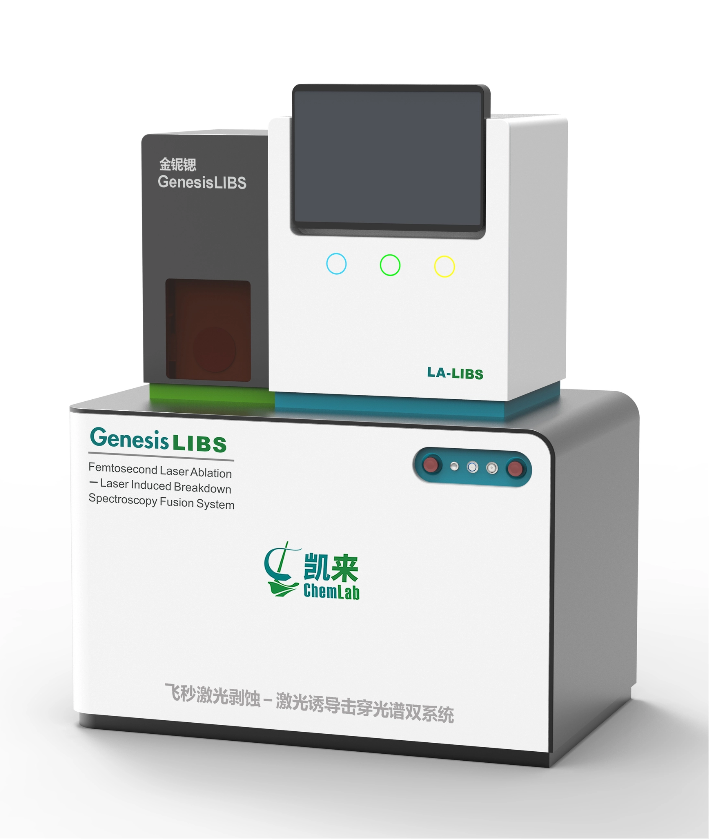


Shanghai ChemLab Instrument Co., Ltd. has independently developed the GenesisLIBS system, the world’s first high-end research platform that deeply integrates matrix-array femtosecond laser ablation (LA) with laser-induced breakdown spectroscopy (LIBS). With a single sampling process, the system acquires high-resolution mass spectrometry and full-spectrum optical spectroscopy data from dual channels, enabling in-situ, micro-area, and rapid analysis of all elements.
 技术特点
技术特点
Technical Features & Key Parameters
Key Parameters
Laser: 343 nm wavelength, variable pulse width high-energy femtosecond laser (pulse width range: 350 fs–1 ps, extendable to 1 ns).
Spectral Detector: Mid-echelle grating + IsCMOS single-photon camera.
Positioning Stage: Nanometer-level high-precision 3D movement stage.
GenesisLIBS: Matrix-array Femtosecond Laser Ablation-Laser Induced Breakdown Spectroscopy (LIBS) Fusion System
Built on matrix-array femtosecond laser ablation technology, the GenesisLIBS system inherits the high stability and precision ablation performance of the GenesisGEO series. It fully leverages the natural advantages of LIBS for detecting light elements (Li, Be, B, C, N, O) and volatile components, providing a comprehensive, blind-spot-free elemental analysis solution for geoscience, materials science, and environmental micro-area research.
The dual-pulse femtosecond laser combines ablation, excitation, and signal enhancement functions, pushing detection limits down to 0.01 ppm with a dynamic linear range covering 0.01 ppm–100%. The matrix scanning module, paired with a mid-echelle grating spectrometer and enhanced IsCMOS detector, enables continuous spot size adjustment from 1–500 µm, with spatial resolution ≤1 µm. This allows for sub-micron high-speed imaging within a centimeter-scale field of view, meeting multi-scale research demands.
Challenges with Traditional LIBS
1. Uncontrollable Transient Plasma:
High-repetition-rate, high-stability lasers and picosecond-level gated detection systems are expensive, leading to signal pulse-to-pulse RSD often >10%.
2. “Qualitative Easy, Quantitative Difficult” :
Matrix effects, self-absorption, and plasma temperature drift result in quantitative errors typically >30%, earning LIBS the reputation of being an “angel for qualitative analysis, but a devil for quantitative analysis.”
Key Breakthroughs of GenesisLIBS
1. Full-Process Steady-State Plasma Capture
Uses a 343 nm wavelength variable pulse width high-energy femtosecond laser, high-resolution mid-echelle grating, and enhanced iSCMOS single-photon detector to visualize the plasma ionization process and precise capture of spectral-MS signals.
Unified hardware architecture: Integrated laser and sample chamber for a dual-sequence LA and LIBS, minimizing costs and eliminating repositioning errors.
2. High-Resolution Imaging & Accurate Quantification – Precise Control of “Time” and “Space”
Femtosecond “cold” ablation replaces traditional nanosecond “hot” ablation, eliminating heat-affected zones and plasma shielding effects.
Coaxial dual-pulse LIBS enhancement combined with MHz-GHz pulse train ablation technology and the matrix system ensures high signal flux for 1–500 µm spot sizes, with spatial resolution ≤1 µm and elemental detection limits as low as 0.01 ppm.
Achieves high-speed, high-resolution, dual-channel elemental imaging and quantification.
3. Synergistic Gain from LA + LIBS
Variable pulse width technology (350 fs–1 ps, extendable to 1 ns) flexibly optimizes LA and LIBS acquisition conditions, enabling optimal synchronous collection or focusing on the performance of one technique as needed.
Aerosols generated by femtosecond laser ablation do not require traditional LIBS dust removal systems, extending the lifespan of optical lenses and chambers—a revolution in dust removal.
Using the same laser system, operation platform, and control or analysis software eliminates the need for calibrating multiple instruments and prevents errors caused by moving samples.
Same physical process, complementary dual-channel signals: Enables synchronous quantitative analysis of all elements.
相关资料
Copyright 2024 Shanghai CHEMLAB Instrument Co., Ltd. All Rights Reserved
Shanghai ICP Filing No.65656565
 Contact us