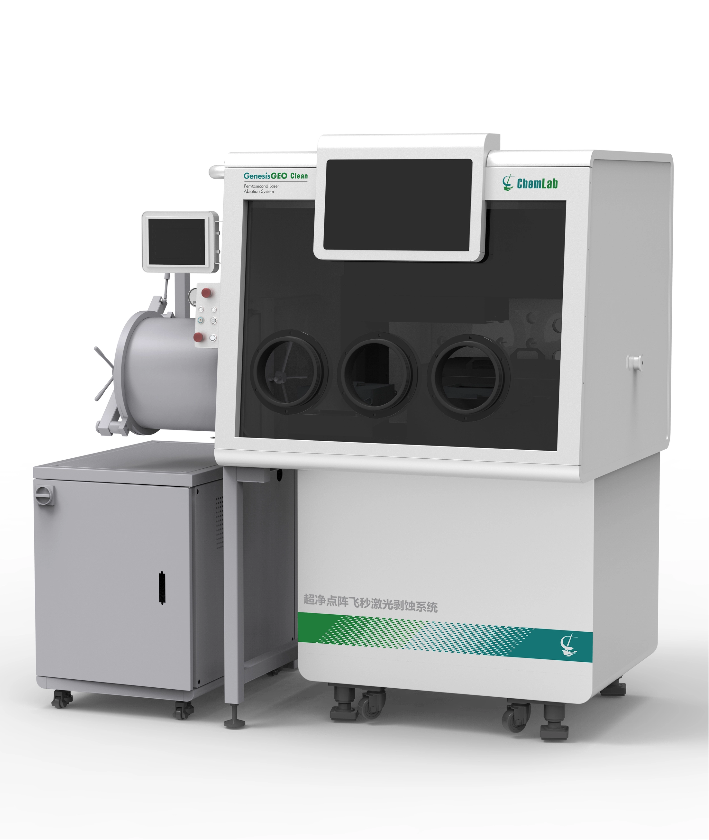
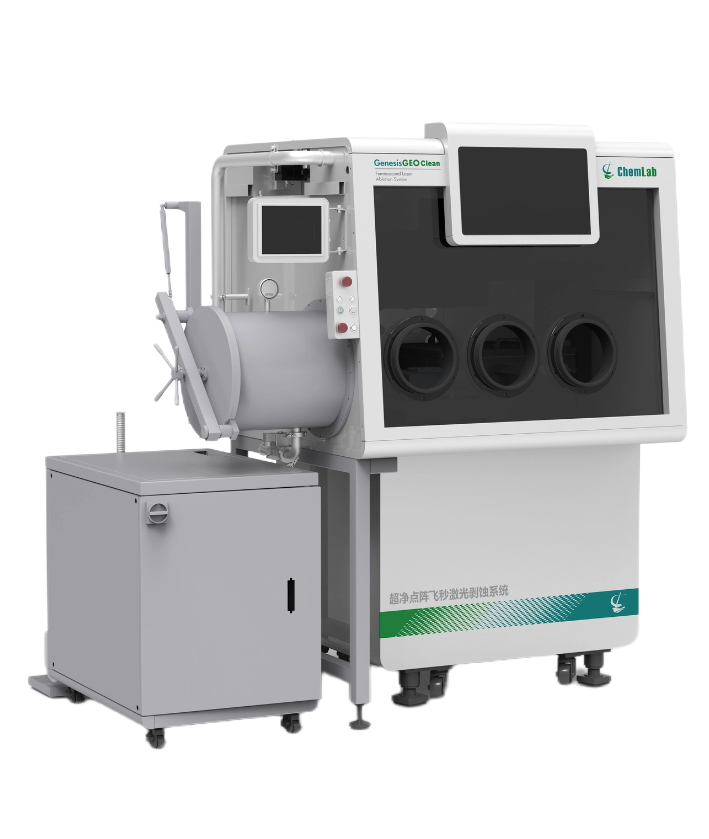


Building upon the high stability and high spatial resolution ablation performance inherited from the GenesisGEO, this system innovatively integrates an ultra-clean main ablation chamber, a sample buffer chamber, and a high-efficiency vacuum displacement system, successfully establishing a fully enclosed ultra-clean environment for the entire "loading-ablation-transport" process. This design systematically resolves contamination issues introduced by ambient air and sample handling during laser ablation. Simultaneously, it eliminates the lengthy chamber purge time required after sample changes in traditional ablation setups, significantly enhancing analytical continuity and testing efficiency. It is suitable for cutting-edge scientific research fields with extreme requirements for experimental cleanliness, such as high-precision isotope analysis, trace detection and imaging of radioactive materials, composition analysis of high-precision semiconductor materials, and impurity detection in high-purity reagents.
 技术特点
技术特点
Contamination: The Core Factor Constraining the Accuracy of Mass Spectrometry Analysis
Contamination is a primary factor constraining the accuracy of mass spectrometry data in chemical analysis. In laser ablation inductively coupled plasma mass spectrometry (LA-ICP-MS), the ablation stage is considered a critical point for contamination introduction, with ambient air being the main source. Suspended particulate matter in laboratory air (often rich in elements such as Na, K, Ca, Mg, Zn, and Pb), aerosols, and surface adsorption phenomena exacerbated by environmental humidity can all introduce significant systematic background signals. Under high-humidity environmental conditions (e.g., during the rainy season or in laboratories in southern regions), particulate matter adheres more readily to the sample and the inner surfaces of the ablation chamber. This leads to elevated analytical backgrounds, reduced signal-to-noise ratios, and ultimately compromises detection limits and data accuracy. Therefore, establishing a fully controlled, ultra-clean environment for sample handling and transport is a critical prerequisite for advancing cutting-edge microanalysis techniques.
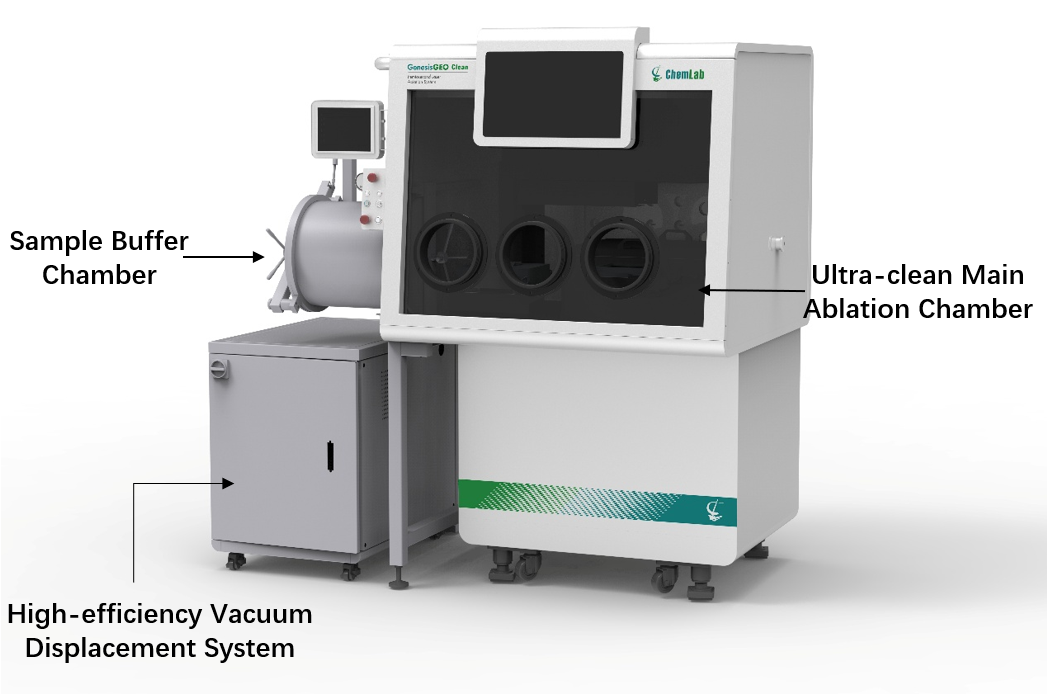
The system integrates an ultra-clean main ablation chamber and a sample buffer chamber with a high-efficiency vacuum displacement system. Users place samples into the buffer chamber, where they undergo displacement through vacuum evacuation and backfilling with high-purity gas, before being transferred to the main ablation chamber. This design ensures that the main analysis chamber remains permanently isolated from the laboratory environment, maintaining a constant, high-purity inert gas atmosphere.
1. Fully Enclosed Ultra-Clean System – Fundamental Contamination Control
The fully enclosed ultra-clean environment established by the GenesisGEO Clean for the entire "loading-ablation-transport" process fundamentally isolates external airborne contamination. This system significantly reduces the analytical background, particularly for isotope systems susceptible to interference from common environmental contaminants, such as 208Pb, 232Th, and 238U in U-Pb dating, as well as for various trace element analyses. It enables more accurate data acquisition and effectively improves detection limits.
2. Stable Gas Flow – Excellent Aerosol Transport Stability
The increased chamber volume provides a more stable gas flow field, reducing turbulence and eddy current effects. Combined with the optimized "small-cup" style transport design, this ensures higher and more stable aerosol transport efficiency from the ablation point to the ICP-MS. This leads to improved short-term precision of data and more accurate correction of elemental fractionation.
3. No Lengthy Chamber Venting and Purging – High Efficiency, Low Cost
This system eliminates the lengthy chamber purge and cleaning process required after sample changes in traditional laser ablation systems. Combined with the buffer chamber design, it rapidly restores the optimal clean environment required for analysis after sample loading, greatly enhancing the efficiency and automation of high-throughput sequential analyses while reducing high-purity carrier gas consumption and operational costs.
4. Large-Volume Chamber – Unprecedented Sample Compatibility and Expanded Applications
The large-volume chamber accommodates a wide range of samples—from micron-scale single mineral grains and thin-film materials to decimeter-scale geological sections and non-destructive in-situ analysis of archaeological artifacts (such as ceramics and oil paintings)—without requiring complex pre-treatment or cutting. This provides reliable support for the compositional analysis of materials in fields such as high-precision isotope geochemistry, nuclear material science and environmental monitoring, and advanced materials science.
应用领域

Quartz U-Pb dating technology enables direct determination of precise timing for hydrothermal veins, mineralization, and low-temperature geological events. Breaking through the limitations of traditional geochronometers, it provides critical chronological evidence for understanding metal ore genesis, tectonic-hydrothermal activities, and basin evolution processes
Carbonate U-Pb dating technology enables direct determination of depositional-diagenetic ages for marine limestones and dolostones, as well as mineralization timing. It provides a precise chronological framework for studying hydrocarbon reservoir evolution, paleoclimate reconstruction, and carbonate-hosted ore deposits
Zircon U-Pb dating stands as the cornerstone of isotope geochronology, acclaimed as the "gold standard" of geological dating. It enables precise determination of critical event timing spanning from the Hadean Eon to the present, including magmatic crystallization and metamorphic overgrowth. Serving as a core tool for exploring Earth's formation, continental evolution, and supercontinent cycles, zircon U-Pb geochronology has fundamentally shaped our understanding of deep time processes
We provide high-precision trace element determination services for geological samples, utilizing LA-ICP-MS, solution ICP-MS, and other advanced techniques to accurately determine elemental concentrations and ratios ranging from major to trace levels in rocks and minerals. Our services deliver critical geochemical data for petrogenetic studies, tectonic setting discrimination, metallogenic process tracing, and paleoenvironmental reconstruction
相关资料
Copyright 2024 Shanghai CHEMLAB Instrument Co., Ltd. All Rights Reserved
Shanghai ICP Filing No.65656565
 Contact us